
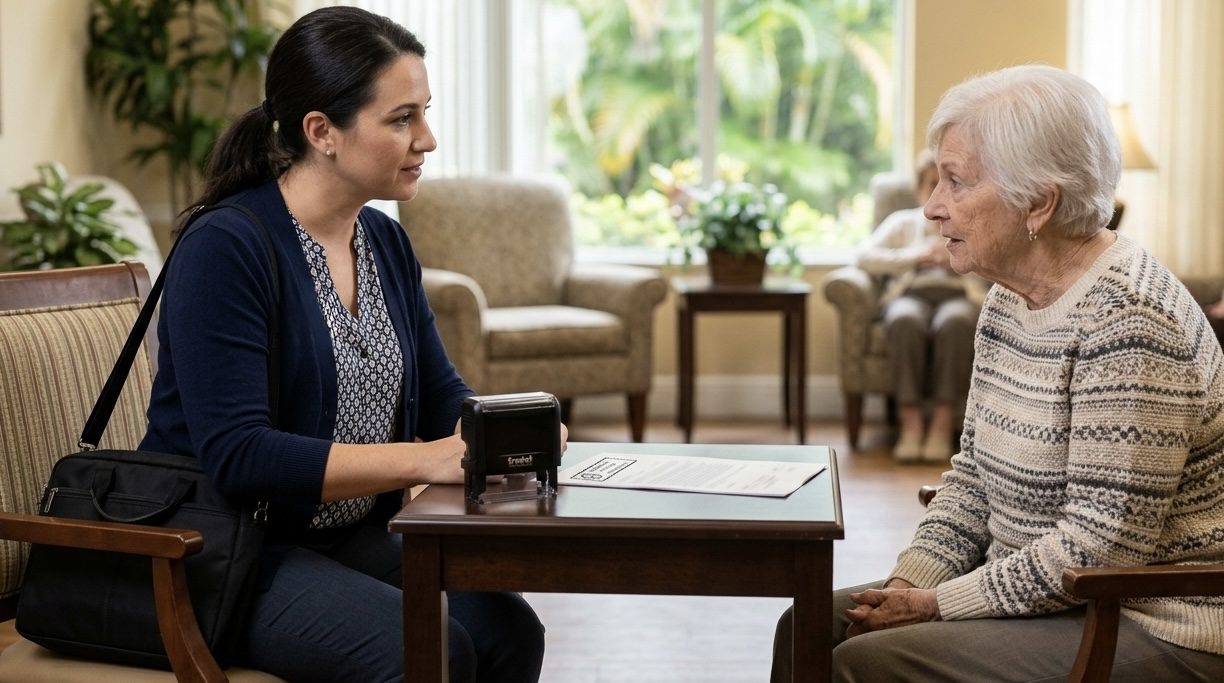
If you need a document notarized in West Palm Beach or anywhere in Palm Beach County, you have two options: visit a notary office in person, or book a mobile notary who comes directly to you. Both are legally valid under Florida law — but depending on your situation, one will be significantly more convenient and cost-effective than the other. Here’s everything you need to know to make the right choice.
A notary public is a state-commissioned official authorized to witness the signing of important documents, verify the identity of signers, and deter fraud. In Florida, both office-based and mobile notaries hold the same legal commission and carry the same authority — the only difference is where the notarization takes place.
Florida law does not distinguish between notarizations performed in an office versus those performed at a client’s location. A mobile notary signature and seal carries exactly the same legal weight as one performed at a notary office — making mobile notary the preferred choice for anyone with time or mobility constraints.
The decision between mobile and office notary comes down to four key factors: urgency, location, document volume, and convenience. Understanding each one helps you choose the right option for your specific situation without overpaying or causing unnecessary delays.
When to Book an Appointment at Our West Palm Beach Office:
- You have a single document and can visit during business hours
- You want notarization done and your apostille request started in one visit
- You want to discuss your document needs with a specialist in person
- You need certified translation at the same appointment
- You prefer to drop off documents and return when they are ready
When to Choose Mobile Notary:
- You are unable to travel due to health, mobility, or time constraints
- You are in a hospital, care facility, or correctional institution
- You need a real estate closing or loan signing at your home or office
- You have multiple signers at a single location who cannot travel
- You need an early-morning, evening, or Sunday notarization (by advance request, subject to availability)
- You require notary service anywhere outside of West Palm Beach across Palm Beach County
Our mobile notary team covers all of Palm Beach County by appointment — including West Palm Beach, Boca Raton, Delray Beach, Boynton Beach, Jupiter, and Wellington. For clients who need both notarization and apostille processing, we recommend starting with an office appointment to streamline the entire authentication chain in a single appointment.
What Florida Law Says About Notary Fees and Travel
Florida caps what a notary can charge for the notarization itself. Under section 117.05(2)(a), Florida Statutes, the fee may not exceed $10 for any one notarial act, with narrow statutory exceptions such as online notarizations, which section 117.275 caps at $25 per act. A notary also may not charge anything for witnessing a vote-by-mail ballot.
The statute sets no rule for travel; it limits the notarial act, not the drive to your home or hospital room. So before booking a mobile visit, ask for the total cost broken out: notarial fees plus any travel or service charge. You can read the fee rule yourself in section 117.05.
What to Prepare Before Any Notarization
Whether you meet us at the office or at your kitchen table, check these before your appointment:
- An acceptable ID. Section 117.05(5) lists the IDs a Florida notary can rely on. They include a Florida driver license or ID card, a U.S. passport, a driver license or ID from another state, a U.S. territory, Canada or Mexico, a U.S. military ID, a VA health ID card, and a USCIS-issued card. A foreign passport works only if it carries a U.S. Bureau of Citizenship and Immigration Services stamp. Every ID must be current or issued within the past five years and must show a serial or other identifying number.
- A complete document. Florida notaries are barred from notarizing a document that is incomplete or blank (s. 117.107(10)). Fill in every blank, or write “N/A,” before the appointment.
- An unsigned document when witnesses are involved. A Florida deed must be signed in the presence of two subscribing witnesses (s. 689.01). A power of attorney needs two subscribing witnesses and the principal’s acknowledgment before a notary (s. 709.2105). A will must be signed in the presence of at least two attesting witnesses, who sign in front of the testator and each other (s. 732.502). Signing early can mean starting over.
- Everyone in one place. For a mobile visit, every signer and witness should be present at the scheduled time.
- A language plan. A notary may not take the acknowledgment of someone who doesn’t speak or understand English unless the nature and effect of the document is translated into a language the signer understands (s. 117.107(6)). If the document itself also needs translating for later use, see our certified translation services.
Hospital, Hospice and Care-Facility Visits
Bedside signings through a hospital notary visit need the most planning. Florida law says a notary may not notarize a signature if the signer appears mentally incapable of understanding the nature and effect of the document at the time of notarization. The same applies when the notary knows a court has declared the signer mentally incapacitated and the document involves a right that was removed (s. 117.107(4)–(5)). If the patient is heavily sedated or confused, or can’t show that they understand what they’re signing, the signing has to wait.
- Schedule for when the signer is usually most alert, and check the facility’s visitor rules.
- Make sure the patient’s ID is on hand. Hospital wristbands are not on the statutory ID list.
- If the signer physically can’t sign, Florida allows a signature by mark, or a notary signing at the signer’s direction. Both require two disinterested witnesses (s. 117.05(14)).
A Third Option: Remote Online Notarization
We also offer Florida remote online notarization (RON). Under section 117.265, a Florida online notary located in Florida can notarize for a signer whether or not the signer is in Florida. The audio-video session must be recorded. Identity is verified remotely through ID credential analysis and identity proofing such as knowledge-based questions.
RON has limits. Remote witnesses must be U.S. residents physically located in the United States or a U.S. territory. For wills, certain trusts, health care advance directives, and certain powers of attorney, remote witnessing is not effective if the signer is a vulnerable adult (s. 117.285(5)). For those signings, in-person witnesses are the safer route.
Quick Decision Checklist
- Can you travel to downtown West Palm Beach during office hours? Book an office appointment at 500 S Australian Ave, Suite 600. We see clients by appointment only, Monday–Friday 9:00 AM–6:00 PM and Saturday 12:00 PM–5:00 PM.
- Is the signer homebound or hospitalized, or are several signers in one place? Book a mobile notary visit during office hours.
- Need an early-morning, evening or Sunday visit? Request it in advance. It depends on availability.
- Signer can’t meet in person but can join a recorded video session? Consider RON, keeping the witness limits above in mind.
- Document going abroad? It may need an apostille after notarization. See how to get an apostille in Florida.
Frequently Asked Questions
Do I need an appointment at your West Palm Beach office?
Yes. The office is appointment-only. Call (561) 475-4757 or use our contact page to schedule.
Is a mobile notary available on Sundays or late evenings?
Mobile visits are scheduled during office hours. Early-morning, evening and Sunday visits are possible only by advance request, subject to availability, so ask as early as you can.
My ID expired last year. Can I still use it?
Possibly. Florida accepts an ID that is current or was issued within the past five years, as long as it shows a serial or identifying number.
Can my spouse, who is a notary, notarize my signature?
No. Florida bars notaries from notarizing the signature of their spouse, son, daughter, mother or father (s. 117.107(11)).
Does a will need to be notarized in Florida?
A Florida will doesn’t need a notary to be valid; it needs at least two attesting witnesses. You can also make it self-proved: the testator’s acknowledgment and the witnesses’ affidavits are made before an officer authorized to administer oaths, such as a notary (s. 732.503). That can be done when the will is signed or at any later date.
Written by Palm Beach County Apostille · Last updated October 14, 2026