
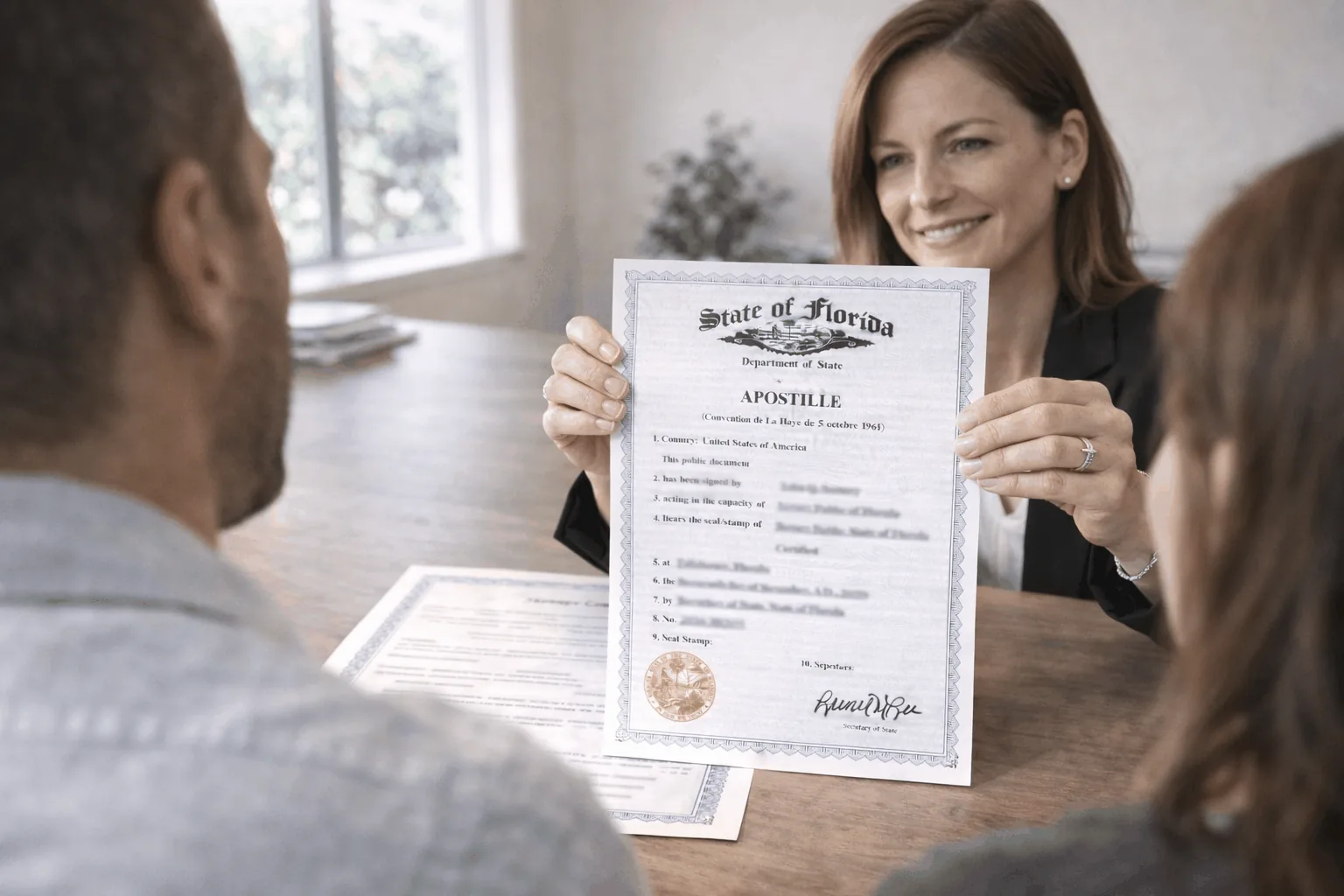
Getting an apostille in Florida can feel overwhelming if you’ve never done it before. Whether you need it for a diploma, birth certificate, marriage license, or corporate document, this guide walks you through every step of the process — so you know exactly what to expect before you begin.
An apostille is an official government-issued certificate that authenticates the origin of a public document for use in another country. Florida apostilles are issued by the Florida Secretary of State and are accepted in every country that is a party to the Hague Apostille Convention — more than 120 countries, including Spain, Italy, Brazil, Mexico, and Germany.
An apostille doesn’t verify the content of a document — it verifies the authenticity of the signature, seal, or stamp on that document, making it legally recognized in foreign countries.
Getting an apostille in Florida is a multi-step process that requires the right documents in the right order. Skipping a step — or submitting an incorrectly notarized document — will result in rejection and delays. Understanding each stage before you start saves you significant time and money.
How to Get an Apostille Fast in West Palm Beach
Working with a professional apostille service in West Palm Beach is by far the fastest and most reliable route. Our team handles the entire process on your behalf — from document review and notarization to submission and return — with same-day rush options available. Step-by-Step Florida Apostille Process:
- Identify your document type — personal, educational, corporate, or legal
- Ensure the document has an original signature and notarization if required
- Submit the document to the Florida Secretary of State for apostille certification
- Receive your apostille-authenticated document, ready for international use
- Rush same-day processing is available through our West Palm Beach office for urgent needs
- International couriering can be arranged for clients sending documents abroad
State processing times vary — the Florida Department of State works requests in the order received and publishes the dates it is currently processing. Same-day and next-day apostille processing is available from our West Palm Beach office for time-sensitive requests. If your document originates from a federal source — such as an FBI background check or federal court document — it must go through the US Department of State rather than the Florida Secretary of State.
If you are unsure whether your document qualifies for an apostille, or which government office handles your specific document type, our West Palm Beach specialists are available Monday through Saturday to assess your paperwork and advise you at no charge.
Who Issues Florida Apostilles and What the State Charges
Every Florida apostille comes from the Apostille Section of the Florida Department of State, Division of Corporations, in Tallahassee. The Secretary of State is Florida’s only competent authority for apostilles, so county offices, clerks and notaries cannot issue one.
The state fee is $10 per document. Documents certified by a Florida Clerk of Court cost $20 per document, which covers the $10 apostille plus a $10 certificate of incumbency. Pay by check or money order drawn on a U.S. bank, payable to the Florida Department of State. Cash and credit cards are not accepted. Details are on the Florida Department of State apostille page.
Submitting by Mail or in Person in Tallahassee
If you mail your documents to the state, include all of the following:
- The Apostille and Notarial Certificate Request Form, with the country where the document will be used filled in.
- The original document or documents.
- A self-addressed stamped envelope or a prepaid, pre-addressed air bill, showing your name and address as both sender and recipient.
- Your check or money order for the correct total.
Regular mail goes to Division of Corporations, Attn: Apostille Section, P.O. Box 6800, Tallahassee, FL 32314-6800. Couriers deliver to 2415 N. Monroe Street, Suite 810, Tallahassee, FL 32303. Requests are processed in the order they arrive.
The state also serves people in person, but only at its Tallahassee office, Monday through Friday from 8 a.m. to 5 p.m., excluding state holidays. The state says most of these requests can be finished while you wait. Most Palm Beach County residents mail their documents or have a service handle the submission.
Certified Copy vs. Photocopy
The state authenticates only original signatures and seals, so photocopies are rejected. What you need depends on the document:
- Florida birth and death certificates must be signed by the State Registrar. You can get them from the Bureau of Vital Statistics or a county health department.
- Marriage and divorce certificates must be signed by the State Registrar or by the Clerk of the County Court.
- Florida public school and university transcripts must be signed by the registrar or another issuing official and carry a full notarial statement.
- Division of Corporations records must be an original certified copy or certificate of status. If you order one with the apostille, pay each fee by separate check or money order.
A Florida notary cannot fix a missing certified copy for you. Under section 117.05, Florida Statutes, a notary may not attest to a copy of a vital record, or of a public record that the record’s custodian can copy. If you need vital records apostilled, order certified copies from the issuing agency first. Birth records issued before 2004 contain limited information, so ask the receiving country’s consulate whether an older certificate is acceptable.
Getting Notarized Documents Right
Powers of attorney, affidavits and consent letters are only as good as their notarization. The state checks each Florida notary’s name, commission number and expiration date against its records. The notarial certificate must be in English and should include:
- The venue, stating where the notary was located at the time.
- The type of act, shown by the word “sworn” or “acknowledged.”
- Whether the signer appeared physically or by audio-video technology.
- The exact date, the signer’s name and the type of ID the notary relied on.
- The notary’s signature, with the notary’s name typed, printed or stamped below it.
- A black-ink rubber stamp seal showing “Notary Public-State of Florida,” the notary’s name, commission number and commission expiration date.
A notary whose commission has expired cannot notarize, and a translator cannot notarize their own translation. Our notarized document apostille service and certified translation team keep these steps in the right order.
Apostille or Certificate? Hague vs. Non-Hague Countries
The Hague Apostille Convention currently has 130 contracting parties, according to the Hague Conference on Private International Law. For countries outside the convention, Florida issues a notarial certificate in place of an apostille. That is why the request form asks for the destination country. The U.S. Department of State then issues authentication certificates for non-Hague countries, and the destination country’s embassy or consulate may require further steps.
Federal documents, such as an FBI background check, skip Tallahassee entirely. They go to the U.S. Department of State’s Office of Authentications with Form DS-4194.
Common Reasons Florida Apostille Requests Are Rejected
- A photocopy was sent in place of an original or a certified copy.
- The notarial certificate is incomplete, not in English, or missing the seal.
- The birth or death certificate is not signed by the State Registrar.
- The payment was cash or a credit card, the amount was wrong, or two required checks were combined into one.
- The document is federal or came from another state, so Florida has no authority over it.
- There was no prepaid return envelope or air bill.
Frequently Asked Questions
Can a Florida notary make a certified copy of my birth certificate for an apostille?
No. Florida law bars notaries from attesting copies of vital records. Order a certified copy signed by the State Registrar.
Does the state accept credit cards for apostilles?
No. Only checks or money orders payable to the Florida Department of State are accepted.
My document was notarized in another state. Can Florida apostille it?
No. A document signed by a notary in another state goes to that state’s competent authority. Our guide to what documents can be apostilled in Florida covers the documents Florida does accept.
Do I need an appointment at your West Palm Beach office?
Yes. Our office at 500 S Australian Ave, Suite 600, works by appointment only. We’re open Monday through Friday from 9:00 AM to 6:00 PM and Saturday from 12:00 PM to 5:00 PM. Call (561) 475-4757 to book a time or to ask about a mobile notary visit.
Written by Palm Beach County Apostille · Last updated October 14, 2026